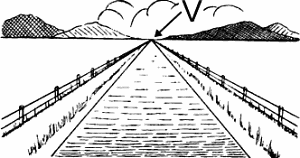
In this week's lectures and readings, I have learned how big of an influence math has in art. The lecture really opened my eyes to how math is used in artwork. The use of math to create perspectives on a flat image was a concept I have never thought that deep into before. I think that it is really cool that we are able to create 3D like images on a 2D surface just with the use of math. The use of a vanishing point is the spot where it seems the farthest from the viewer. The image below displays how the use of perspective and a vanishing point is used in art to show how a drawing can appear 3D. The areas that seem the closest to the viewer appear bigger because they are supposed to be shown as if they are right next to the viewer, while the farther areas are smaller because they are supposed to be in the distance. Dimensions would be hard to show on a piece of paper without showing the perspective. Edwin A. Abbott's explains how perspective contributes to the art world. He explains how if you put a penny on a table and look at it from above, you will see a circle. Once you look at it moving down towards the edge of the table, it appears more oval. Once you reach the edge of the table, it will appear a straight line.
Additionally, math like simple lines and shapes are used to create art. Circles, squares, triangles, and lines are very common shapes to create artwork due to their universal nature. When young children learn to draw or create drawings on their own, they are using basic shapes as guidelines. I learned how to draw images and animals through basic shapes like circles and squares. As seen in the image below, shapes and lines help act as guidelines for more complex drawings.
Science, art, and math can also all come together to create masterpieces as well. Nathan Selikoff created digital art "Beautiful Chaos." The user interacts with the software which has underlying mathematical equations which helps create abstract images the user can create with their hands. Selikoff's art is a perfect example of how art, science, and math can all go hand in hand and work together. Views of math, science, and art having nothing to do with each other is obscure because without each one, the others would not work as well.

Sources:
Lesson 3: Vanishing Points and Looking at Art, http://www.cs.ucf.edu/courses/cap6938-02/refs/VanishingPoints.pdf. Accessed 8 April 2022.
“Beautiful Chaos - Interactive Software Art.” Nathan Selikoff, https://nathanselikoff.com/works/beautiful-chaos. Accessed 8 April 2022.
“How to Draw: Animals Using Shapes.” The Lightbox, 25 July 2020, https://www.thelightbox.org.uk/blog/how-to-draw-animals-using-shapes. Accessed 8 April 2022.
Abbott, Edwin A. "The Flatland". 1884
Desma 9 Week 2 Lectures

Hi Sydney -
ReplyDeleteI also really enjoyed learning about how mathematics influences art. I had never really thought about this in depth before; although, looking back on my art projects in elementary school through high school, I can see how mathematical concepts are involved (i.e., geometry, graphing, symmetry). I liked how you described how art can take the perception of the experience of life within a 3D surface to an illustration on a 2D surface. I liked your discussion of vanishing point and the images you included were really interesting. I really enjoyed reading your blog post for this week!
-Julia